

According to TruckInfo.net, as many as 13.5 million trucks are registered and plying U.S. roads today. This is in the context of commercial trucks whose gross weight is over 10,000 lbs., so it only includes straight and semi trucks. All in all, they moved over 70% of overall freight tonnage within and beyond the border.
That much freight shows that trucks remain the masters of getting goods from point A to B and back. Planes, ships, and trains may move more goods, but only trucks can carry them to their exact destination further inland. In the end, there are way more miles of road than there are airports, seaports, and miles of rail.
That said, truckers need to be aware of their route. Not all roads are ideal for trucks, such as steep grades and low clearances (looking at you, 11foot8). However, a truck with a GPS onboard helps map the best route to their destination and back.
Satellites: A Trucker’s Best Friend
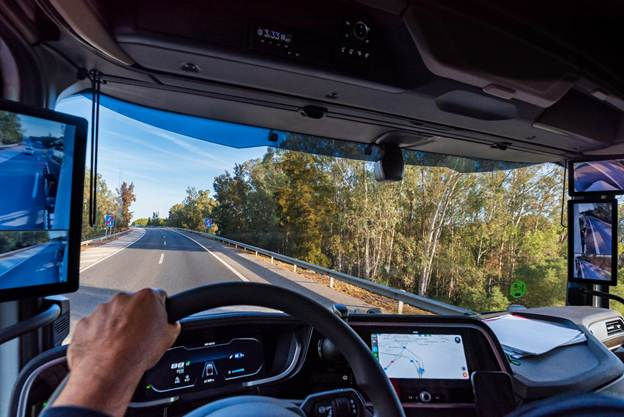
Satellite navigation is so ingrained in modern trucking that a day in a trucker’s life without it is unimaginable. It all but eliminates the need to keep a bunch of maps and notes on hand, let alone briefly pull over to get their bearings.
All this is made possible with a technology known as the Global Positioning System (GPS). It was initially designed for military use in 1973, with arguably its most famous application being contributing to the Coalition’s victory in the Gulf War. But as later GPS suites shrank in size but improved in capability, the tech soon found its way into the commercial sector.
The GPS consists of three parts: the satellites, ground stations, and receivers.
- GPS Satellites: A total of 31 satellites orbit the Earth at over 12,000 miles above. Their job is to emit signals to be received on the surface continuously.
- Ground Stations: As an internationally available system, GPS maintains ground stations worldwide to monitor each satellite’s position.
- Receivers: This device comes with the truck’s GPS. It receives signals from at least four satellites to show the equipped truck’s location.
Standard GPS suites for commercial trucks update location data at a speed of 1 Hz or one cycle every second. Faster speeds of 5 to 10 Hz are often reserved for high-speed vehicles such as aircraft.
According to the Federal Aviation Administration, GPS services provide location accuracy within seven meters of the receiver. Weather conditions and natural obstructions such as mountains affect signal strength but usually aren’t enough to disrupt navigation.
In fact, they become less of a problem if truckers shop top-rated truck GPS devices. These units are built for the rugged, mobile lifestyle associated with trucking, featuring accuracy under bad weather and resilience to last long journeys. They can also be used for planning stops for fuel, food, and rest.
How GPS Benefits Trucking
Anyone working for a company that offers same-day delivery knows the burden that comes with delivering goods on time. Trucks are far from the fastest vehicles on the road, and the weight of a fully loaded trailer can impact speed and fuel consumption. On the other hand, businesses stand to lose if they’re unable to fulfill their delivery promises.
GPS tracking is a godsend for the trucking industry as a whole, as the American Journal of Transportation explains.
Real-Time Tracking
Truckers aren’t the only ones who need to know exactly where they are right now. Trucking companies are particular about locating their commercial trucks, especially if they deliver across state lines and border crossings. Each truck that goes off the radar is a sleepless night for both the company and, more importantly, the client.
Telematics—the practice of monitoring fleets or commercial vehicles like trucks—uses GPS technology for real-time tracking (along with other technologies). Similar to onboard GPS navigation, fleet management systems track units with GPS receivers. The real-time data can then be shared with clients, mainly through proprietary or third-party apps.
Route Optimization
The U.S. has the most extensive road network in the world, with a total of 4.1 million miles of paved and unpaved roads. But as mentioned earlier, not all roads are suitable for trucks. No trucker can afford to have a low bridge open the trailer like a can of sardines.
Fortunately, GPS technology has reached the point where it can show its location relative to local mapping data. This data comes from a wide range of sources, from GPS satellite imagery to real-time traffic from authorities and online map users. Using its onboard algorithm, the truck’s GPS calculates the most efficient route to the destination.
However, the real benefit isn’t so much speed but fuel usage. One study by Chinese researchers found that, compared to a five-ton truck, 15-25-ton trucks use 290% more fuel and 45-55-ton trucks 755%. GPS navigation equipped with deep learning takes weight, road closures, and other factors into account when planning optimal routes.
Predictive Maintenance
Between their long-distance travels and the environments they go through, trucks accrue wear and tear quickly. The last thing a trucking service needs is for one or more of its fleet trucks to be unusable or break down along the way. Fixing a problem when it rears its ugly head won’t do; it must be fixed before it gets the chance.
GPS technology enables certain features that are crucial for predictive maintenance, such as geofencing. By designating areas on the map, monitoring systems can notify companies if any of their trucks have passed through them. There are various reasons for cordoning an area via geofencing, such as tracking driver behavior or flagging geographic features.
Traffic through geofenced areas is important data for determining whether or not a truck already needs maintenance. This way, fleet operators can anticipate the materials and kind of maintenance it’ll need. The data can also be used for studying truck accidents.
Theft Prevention
Real-time tracking serves another purpose: safeguarding fleet trucks from thieves. It isn’t unusual for a trucker with criminal intent to deviate from their standard course or overlap with another trucker’s area of operation.
Fleet management software can easily track the location of every unit with a fleet tracking device installed. As soon as a truck’s location moves to somewhere it shouldn’t be, the operator will be notified. Quick action on their part helps avoid costly material losses.
Conclusion
The GPS does a lot more than simply track a truck’s location with unparalleled accuracy. From real-time tracking to theft prevention, this is one must-have technology for logistics services or businesses that operate trucks. It can mean the difference between success and failure in delivering goods exactly where they need to be.


